Call Us Now!
Serving Cooper City, FL
Fast, Clean, and Professional Stump Removal.
Stump Grinding Tips & Tree Care Insights
Contact Us
What Happens If You Leave a Tree Stump in Your Yard Too Long?
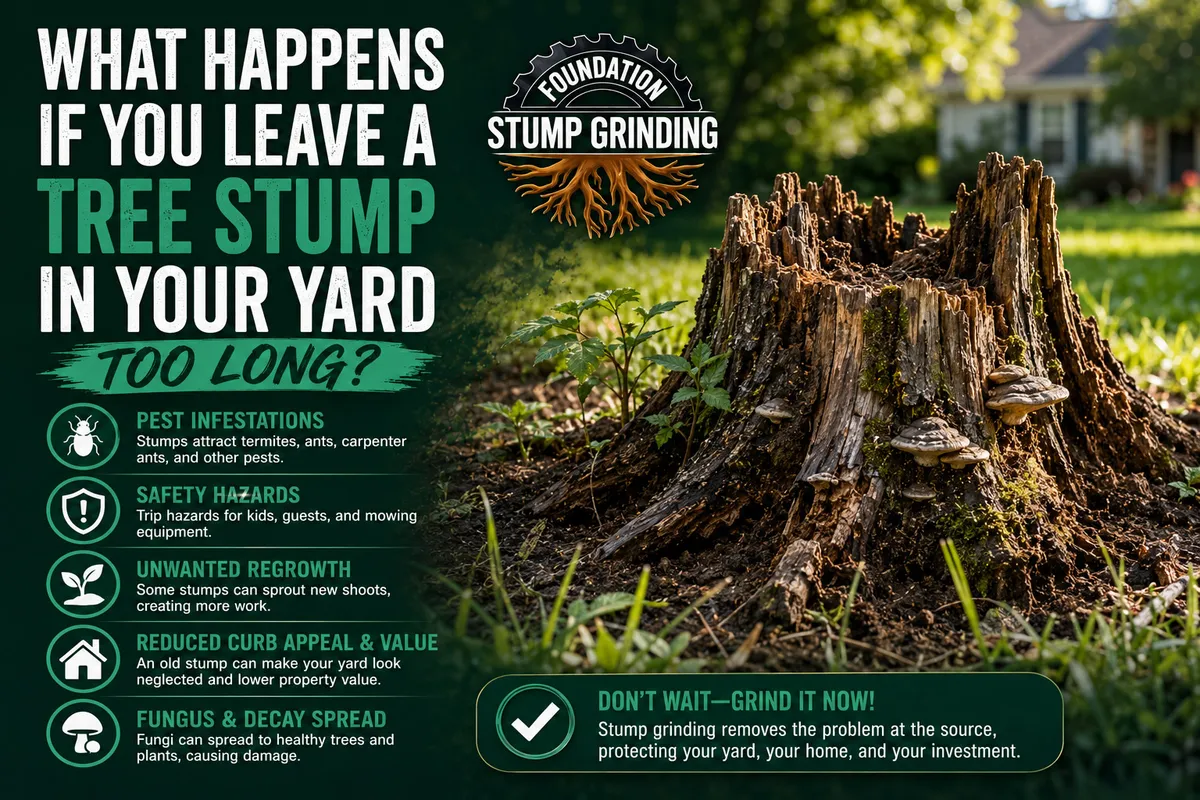
When a tree is cut down, the stump that remains tends to get ignored. It is not urgent. Nothing visible is happening. There are other things to deal with. This is one of the most common mistakes property owners in Cooper City, FL make, and it is understandable because the consequences of leaving a stump in place do not announce themselves immediately. They build quietly over months and years, and by the time they become obvious, the cost of addressing them is significantly higher than the cost of grinding the stump would have been from the start. This article covers exactly what happens when a stump is left in place for too long.
The First Year: Decay Begins and Pests Move In
The first visible change after a tree is cut is the stump beginning to dry out and crack. This process happens faster in Broward County's heat than in cooler climates. As moisture leaves the wood and the surface cracks, it creates entry points for insects and fungi.
Within the first twelve to eighteen months, many stumps in South Florida begin showing signs of insect activity. Termites, carpenter ants, and wood-boring beetles are drawn to the decaying cellulose. At this stage the infestation is localized to the stump. The critical question is whether it stays there, and in many cases near structures, it does not.
Pest Migration: When the Problem Leaves the Stump
A stump near your home, a wooden fence, a deck, or a shed is a direct pathway for insect colonies to migrate to those structures. Once established in a nearby structure, termite infestations are expensive to treat and the structural damage they cause is not covered by most standard homeowners insurance policies.
Homeowners in Cooper City, FL who have dealt with termite damage tracing back to a backyard stump consistently describe the same pattern: the stump seemed harmless, and then one day an inspection revealed active colonies in the fence posts or wall framing. The repairs cost thousands. The grinding that could have eliminated the risk would have cost a fraction of that.
Years Two Through Five: Regrowth and Root Spread
Many tree species native to or common in Broward County are persistent growers. Even after the main trunk is removed, the root system continues to live and, in many species, continues to produce new growth. The following types of regrowth are commonly seen in the years after a tree is cut in Cooper City, FL.
New shoots growing directly from the stump surface, sometimes reaching several feet in height within a single growing season
Root sprouts emerging from the ground several feet away from the original stump location
Surface roots expanding laterally and creating uneven ground across the lawn
Root intrusion into irrigation lines, drainage systems, or underground utilities
Each of these problems requires ongoing maintenance to manage, and root intrusion into utilities or drainage can trigger repair costs that dwarf the original stump grinding price.
Long-Term Consequences: Structural and Property Impact
Left for five years or more, a stump and its decaying root system can create more serious structural and property-wide issues. As the wood fully decomposes underground, voids can form in the soil above the root mass. In the right conditions, these voids cause ground subsidence, which is the gradual sinking of soil that can affect anything built above it, including patios, walkways, driveways, and in some cases, foundation elements.
From a property value standpoint, stumps that have been in place for years are visible red flags during real estate inspections. They signal neglected maintenance, raise questions about pest activity, and can complicate the sale of a home in Broward County's competitive real estate market.
Frequently Asked Questions
At what point does a stump become a permanent fixture underground?
Stumps do not truly become permanent, but very old stumps that have been decaying for ten or more years may have root systems that are deeply integrated into the surrounding soil. They can still be ground down, but the process may be more complex than a fresh stump.
Can a decaying stump affect nearby healthy trees?
Yes. Fungal diseases that develop in a decaying stump can spread through shared root systems to nearby living trees. If you have valued trees in the vicinity of a decaying stump, removal is worth considering from a plant health standpoint.
Does the species of tree affect how fast the stump decays and what problems it causes?
Significantly. Fast-growing softwoods decay more quickly, while dense hardwoods like oak can remain intact for many years. Regrowth-prone species like laurel oak and Brazilian pepper present more aggressive regrowth problems regardless of decay rate.
Is there a way to tell if a stump has already attracted termites?
Signs include visible termite tunnels or mud tubes on the stump surface, hollow-sounding wood when tapped, sawdust-like frass accumulating at the base, and winged termites emerging from the wood during swarm season.
How do I know if my stump is close enough to my home to be a real pest risk?
General guidance suggests any stump within fifteen to twenty feet of a wooden structure carries meaningful migration risk in South Florida's termite environment. Closer proximity increases risk proportionally.
Do Not Wait Until the Problem Declares Itself
The pattern is predictable: the stump is ignored, the problems develop invisibly, and by the time they surface they cost far more to fix than the original grinding would have. Cooper City, FL homeowners and commercial property owners across Broward County are well served by addressing stumps early, before they become a source of ongoing expense. Foundation Stump Grinding removes stumps efficiently and completely, eliminating the risks before they compound. Call 754-296-6966 to schedule service.

© 2026 All Rights Reserved | Foundation Stump Grinding
Website Done By: LocalEyes